We know the effects of climate change: glacier melting, stronger storms, and rapid ocean acidification, but sometimes we don't understand how it can personally affect our everyday lives. In reality, it's directly related to your socioeconomic status, the quality of food you eat, respiration, and more.
San Francisco — Agriculture
Did you know that more than a third of the country's vegetables and nearly three quarters of the country's fruits and nuts are grown in California?
Unfortunately, according to the U.S. Department of Agriculture, fluctuations between dry and wet years as well as rising temperatures have made predicting the future of some crops challenging (Bay Area 2050). One crop in danger is… grapes.
Rising temperatures, unpredictable weather, and bad air quality through wildfires all threaten California vineyards by affecting grape quality, flavor, and yields.
But not to worry, you'll likely still be eating grapes 20 years from now. Growers are adapting by planting more heat-tolerant grape varieties, such as grapes with smaller vines.
Although grapes, among some other plants, may still have a future, a lot of other crops are in danger. Agriculture is one of the major sectors affected by (and impacting) climate change, and it is also vital to our survival and health.
San Francisco — Wildfires
San Francisco, LA, and California in general have had a lot of wildfires. In fact, California is the state with the most wildfires annually, something that will only worsen as climate change continues.
By 2050, environmental scientists predict the amount of forested land burned in wildfires in Northern California will increase up to 52 percent without mitigation efforts.
Wildfires and drought have a very intimate relationship: they both fuel each other. Since climate change is increasing the amount of droughts, the land is getting drier than it already is. In turn, drier land is making wildfires all the more likely.
Although there aren't many ways to stop wildfires, it may be of consolation that “The State Fire Marshal is required to maintain and update Fire Hazard Severity Zones. The zones are based on a model that assigns a hazard score for factors that impact fire likelihood and behavior over 30 to 50 years without taking mitigation measures into account” (Bay Area 2025).
Wildfires are destructive as it is, but it's even worse that they add on ANOTHER huge problem: worsening air quality. Bad air quality causes some major health problems, both respiratory and cognitive impairment. This makes taking action on climate change all the more serious. Forget “climate change” — it's more of a climate emergency.
San Francisco — Drought
Funnily enough, climate change causes not only sea levels to rise but causes droughts — its seemingly opposite — to increase as well!
According to the Yale Project on Climate Change Communication: “Nearly half of all San Franciscans (47%) believes drought in the area has become more severe over the past several years. Of those who believe global warming is happening, a solid majority (72%) say that it has had at least a moderate influence on the severity of drought, while only 9% say global warming has had no influence.”
Did you know that drought in California and Nevada is a common occurrence that can last for multiple years? Droughts are already common in California, and they will become even more common, all thanks to climate change.
One, perhaps obvious, solution is to minimize the amount of water you waste. We often don't realize it, but we can end up wasting a huge amount of water. Whether it means minimizing your shower time or fixing leaks in sinks, there's always a way to reduce your water usage. This way, you're not only helping mitigate climate change further, but you're also reducing your water usage bill!
San Francisco — Erosion
According to a California Climate Change Report, by 2050, statewide damages could reach almost $17.9 billion from destroyed residential and commercial buildings due to sea level rise and coastal erosion.
The website Bay Area 2050 states that “The higher the sea level gets, the more erosion and the faster the erosion will occur. And it's accelerating. Short term extreme events, such as hurricanes and tsunamis, are increasing at the same time the ocean is warming. That means more energy and stronger storm events. This contributes to further erosion along the coastline.”
Unfortunately, we haven't found a solution or way to mitigate this erosion, so for now, the best way to solve this is to put our efforts into mitigating climate change itself, because fixing erosion or drought is like putting on a Band-Aid: it helps for a while, but won't stop the ultimate problem.
Rising Heat and Climate Injustice
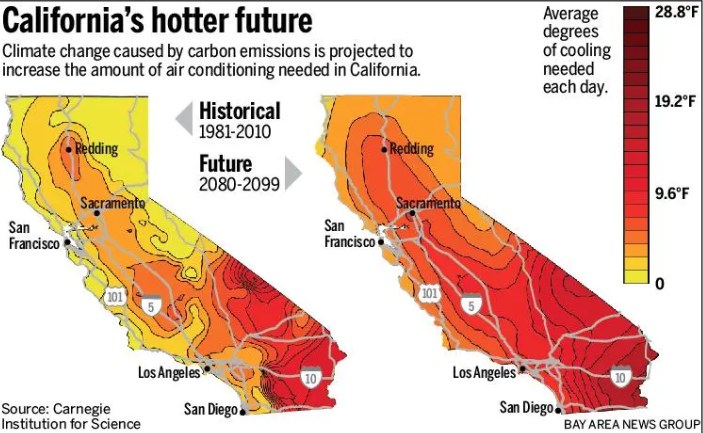
It's said that “In a typical year around 1990, people in San Francisco, CA experienced about 7 days above 79.5ºF in a year. By 2050, people in San Francisco are projected to experience an average of about 18 days per year over 79.5ºF” (Climate Check).
This problem is really one that reveals the injustice San Francisco faces: those who are rich can better afford ACs and cooling units, and fare much better than the poor, who may not have enough money to afford cooling units or even a house, leaving them to suffer in the sun's now cruel heat.
And now, we may even be hearing that San Francisco's cooling layer of fog is leaving too? Yikes — the Bay Area really IS being impacted by climate change.
References
“Bay Area 2050”: Impacts of climate change on the local environment. (2025). In ABC7 San Francisco. https://abc7news.com/feature/bay-area-2050-impacts-climate-change-local-environment/14828815/
Jimenez, G. (2025). A fog-free San Francisco? Scientists ponder California's climate future. In Department of Land, Air and Water Resources. https://www.lawr.ucdavis.edu/news/fog-free-san-francisco-scientists-ponder-californias-climate-future
Leiserowitz, A., Feinberg, G., Howe, P., & Rosenthal, S. (2013). Climate change in the San Franciscan mind. Yale Project on Climate Change Communication, Yale University. https://climatecommunication.yale.edu/app/uploads/2016/02/2013_10_Climate-Change-in-the-San-Franciscan-Mind.pdf
San Francisco Bay Area Region Report CLIMATE CHANGE ASSESSMENT Introduction to California's Fourth Climate Change Assessment. (n.d.). Retrieved August 2, 2026, from https://www.energy.ca.gov/sites/default/files/2019-11/Reg_Report-SUM-CCCA4-2018-005_SanFranciscoBayArea_ADA.pdf
San Francisco, California Climate Change Risks and Hazards: Drought, Precipitation. (n.d.). In climatecheck.com. Retrieved August 2, 2026, from https://climatecheck.com/california/san-francisco
The Future of Fog. (n.d.). In Public Policy Institute of California. Retrieved August 4, 2026, from https://www.ppic.org/blog/the-future-of-fog/