Introduction
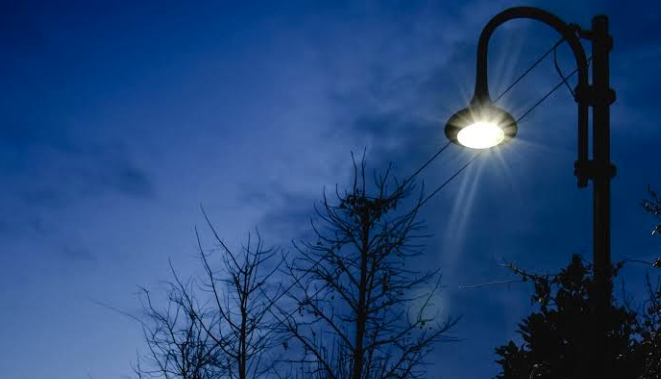
Imagine you’re coming back from work, sitting in a bus or walking on the sidestreet, you can see the city lights everywhere, brightening up the city like nights being dark is a myth. The whole city is buzzing every second, not resting at all.
But the lights don't let us rest as well. Let’s understand how:
The Light Darkens Our Eye Bags
Back in the 2000s, the city lights were usually sodium bulbs that emitted yellow-orange light (higher wavelength) but since the 2010s, they have been switched to White LEDs for energy efficiency. The blue light — shorter wavelength than yellow-orange lights — coming out of the White LEDs scatters easily in the atmosphere, thus lightening up (skyglow) like it’s meant to but it has its disadvantages.[2]
Blue Light and Biology
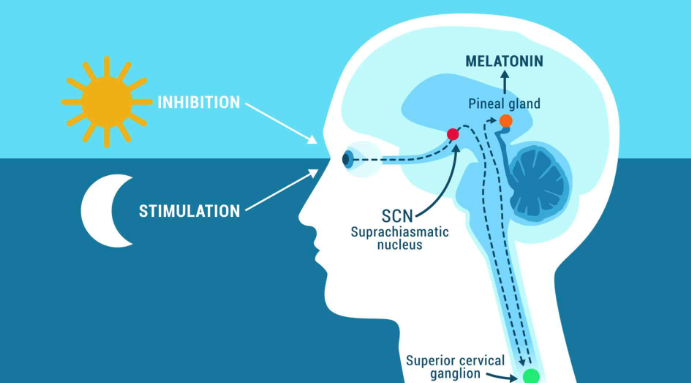
Our circadian rhythm is maintained in a 24 hour cycle and several hormones. One of the primary sleep-promoting hormones is melatonin (everyone must have heard of it somewhere!) so when melatonin’s production is less or stopped in our brain or body, we lose our sleep.
So now the question arises, what circumstances lead to less or no melatonin in our body and where are the city lights in this equation?
From your office to home, you see city lights — emitting blue light — at every corner of a street. Your eyes have specialised cells called ipRGC which are triggered by blue light. Creepy! These specialised cells are awakened but what do they do?
They signal our SCN (the part of our brain which regulates the 24 hour day cycle) to send negative feedback to the pineal gland which produces melatonin when it’s time to sleep.[1]
No wonder we’re asked to not watch screens two hours before bed!
Impact of City Lights
Therefore, every time you have a screen or LED switched on around your bedtime, you do everything except sleep and in no time, it's 3 in the morning.
Around 22% prevalence increase in sleep problems is observed due to the light pollution.
One of the common sleep problems we know is INSOMNIA. Light pollution has been a major contributor to chronic insomnia observed in people over the last decade.
The everyday light exposure leads to:
- Sleep fragmentation
- Mental fatigue
- Stress
- Metabolic imbalance
- Insomnia (it’s serious so don’t mind a double mention)
- And a lot more! [3]
So clearly, there’s a big problem — enlightened quite literally (that’s my sense of humor. nevermind).
We need better urban city planning that does not drain our energy while it lightens up our skies at night more than necessary. (let us sleep! thanks!)
Measures We Can Take
Here are some things we can adopt to have a SUSTAINABLE environment for us and the nature:
At Municipal level:
- Shielding outdoor fixtures
- Dimming late at night
- Warmer color temperatures (below 2700K)
At Individual level:
- Blackout curtains
- Reducing late-night screen exposure
- Using warm-spectrum indoor bulbs
Note From a Sleep-Deprived Human
You never know what comes next. First we let the industries pollute our air then let them disturb our sleep. What next? We, as humans, should build a space that does not just benefit us but everything around us. But here we are, doing the exact opposite!
It is the earth letting us stay; not the other way around and we are extracting every bit from it as we can. When we take too much than what someone gives, at some point it's gonna backlash. Let's not wait for that time. We’ve taken enough, let the earth rest for a while.
References
Berson, D. M., Dunn, F. A., & Takao, M. (2002). Phototransduction by retinal ganglion cells that set the circadian clock. Science, 295(5557), 1070–1073. (Covers ipRGCs and their connection to the SCN.)
Falchi, F., et al. (2016). The new world atlas of artificial night sky brightness. Science Advances, 2(6), e1600377. (Covers the transition to white LEDs and skyglow statistics.)
Koo, Y. S., et al. (2016). The outdoor light at night on sleep problems in elderly adults. Journal of Clinical Sleep Medicine, 12(9), 1223–1228. (Covers sleep disruption and insomnia rates linked to ALAN.)
Cho, Y., et al. (2015). Effects of artificial light at night on human health: A review. Chronobiology International, 32(7), 994–1007. (Covers melatonin suppression and metabolic impacts.)