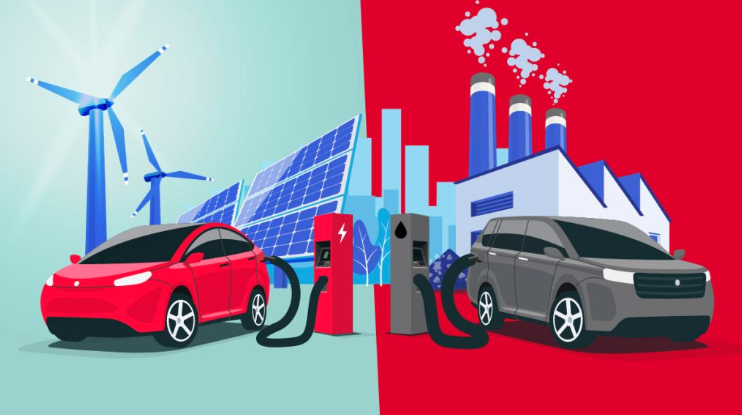
"I'd rather drive a gas car than an electric one."
A friend said this to me recently, convinced that electric vehicles (EVs) were little more than greenwashing, the deceptive practice of making a product or company appear environmentally friendly when it actually is not. His reasoning sounded convincing enough: lithium mining destroys ecosystems, battery production emits massive amounts of carbon dioxide, and replacing millions of gasoline cars with giant batteries simply shifts pollution somewhere else.
It seems logical, but is it true?
The short answer is no. While electric vehicles are far from environmentally perfect, decades of research consistently show that they produce substantially fewer greenhouse gas emissions over their lifetime than gasoline-powered vehicles. The key is looking beyond the battery factory and examining the vehicle's entire life cycle.
Yes, Battery Production Is Carbon Intensive
Critics often point to the production of lithium-ion batteries, and they're not wrong.
Mining lithium, nickel, and cobalt requires significant amounts of energy and water. Manufacturing a battery also produces more carbon emissions than building a conventional internal combustion engine. According to researchers at the International Council on Clean Transportation (ICCT), manufacturing an EV can initially generate 40–70% more emissions than manufacturing a comparable gasoline vehicle, largely because of battery production.
If the story ended there, critics would have a point.
The "Carbon Debt" Doesn't Last Long
Fortunately, it doesn't.
Think of battery manufacturing as paying a larger environmental cost upfront.
Once an EV is on the road, however, that debt begins shrinking with every mile driven. Unlike gasoline vehicles, which continue burning fossil fuels every day for their entire lifespan, electric vehicles become cleaner over time as they draw electricity from increasingly renewable power grids.
Researchers at the Massachusetts Institute of Technology (MIT) estimate that in the United States, the average electric vehicle offsets the extra emissions from battery production after roughly one to two years of driving. After that point, every additional mile widens the emissions gap between EVs and gasoline cars.
The battery may begin with a larger carbon footprint, but it does not stay that way.
What About Lithium Mining?
That still leaves one major concern: the battery itself.
Lithium extraction deserves criticism.
Mining operations can strain local water supplies, disturb ecosystems, and affect nearby communities if poorly managed. Researchers have documented these concerns, particularly in South America's Lithium Triangle.
However, comparing lithium mining to gasoline production often overlooks an important difference. Gasoline requires continuous extraction. Every gallon burned must be replaced by drilling, transporting, refining, and burning another gallon of oil.
Lithium, on the other hand, is mined once. The battery then stores and delivers energy for years before it can be repurposed or recycled. According to researchers at Argonne National Laboratory, advances in battery recycling could recover much of the lithium, nickel, and cobalt from retired batteries, reducing the need for future mining altogether.
"But What Happens When Everyone Throws Away Their Batteries?"
Even if EVs emit less carbon while driving, what happens after ten years when the battery wears out? Won't millions of lithium-ion batteries simply become mountains of hazardous waste?
The evidence suggests otherwise.
First, most EV batteries outlive what many people expect. According to researchers at the U.S. Department of Energy's National Renewable Energy Laboratory (NREL), modern lithium-ion batteries are projected to last 15 to 20 years under normal driving conditions, with many retaining over 70–80% of their original capacity even after they are no longer ideal for transportation.
That remaining capacity gives batteries a "second life." Instead of being discarded, retired EV batteries are increasingly repurposed to store electricity for homes, businesses, and renewable energy projects. Nissan has reused batteries from its Leaf vehicles for street lighting systems, while companies such as B2U Storage Solutions in California use retired EV batteries to store solar energy for the electrical grid.
Eventually, when the battery truly reaches the end of its useful life, recycling becomes the next step. Researchers at Argonne National Laboratory estimate that modern recycling technologies can recover the vast majority of valuable materials, including lithium, nickel, cobalt, and copper, allowing them to be used in manufacturing future batteries. Companies such as Redwood Materials, founded by former Tesla Chief Technology Officer JB Straubel, and Li-Cycle are already building large-scale recycling facilities to create a more circular battery supply chain.
In contrast, a gasoline-powered car releases carbon dioxide into the atmosphere permanently. Once combusted, the fuel is gone forever and cannot be recovered or reused. A lithium battery, by comparison, is a durable product. Its materials can power a vehicle for well over a decade, serve a second purpose storing renewable energy, and ultimately be recovered to manufacture another battery.
Looking at the Bigger Picture
Electric vehicles are not perfect. They require mining, energy, and manufacturing, all of which carry environmental costs.
But virtually every major scientific organization that has studied the issue, including the International Energy Agency (IEA), the Intergovernmental Panel on Climate Change (IPCC), the U.S. Department of Energy, and the International Council on Clean Transportation, reaches the same conclusion: over their lifetime, electric vehicles produce substantially fewer greenhouse gas emissions than gasoline-powered cars.
The debate, then, should not be whether EVs are perfect. It should be how we continue making them better through cleaner mining practices, improved battery recycling, and a more renewable electric grid.
References
International Council on Clean Transportation. (2025, July 18). Life-cycle greenhouse gas emissions from passenger cars in the European Union: A 2025 update and key factors to consider. https://theicct.org/publication/electric-cars-life-cycle-analysis-emissions-europe-jul25/
MIT Climate Portal. (n.d.). Are electric vehicles definitely better for the climate than gas-powered cars? Massachusetts Institute of Technology. Retrieved July 10, 2026, from https://climate.mit.edu/ask-mit/are-electric-vehicles-definitely-better-climate-gas-powered-cars
Argonne National Laboratory. (n.d.). Battery material supply & recycling. U.S. Department of Energy. Retrieved July 10, 2026, from https://www.anl.gov/access/research/projects/battery-material-supply-recycling