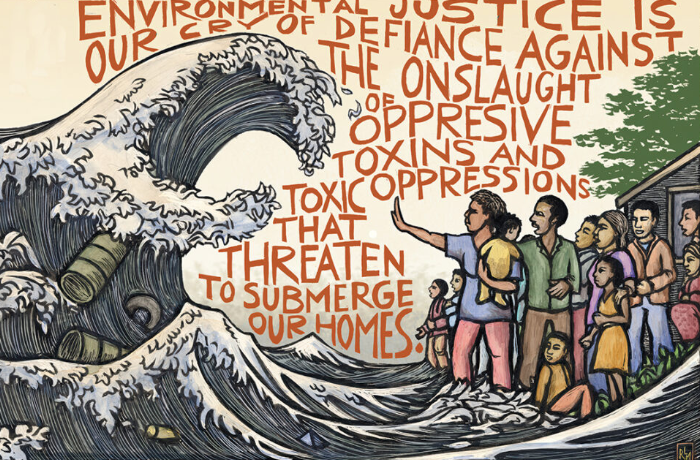
We'll dive into what environmental justice is, why it's important, and how it ties into public health and other problems.
Environmental Justice: What IS it and why is it so important?
According to the American Public Health Association (APHA), environmental justice is "the idea that all people and communities have the right to live and thrive in safe, healthy environments with equal environmental protections and meaningful involvement in these actions."
This is a very important concept, because oftentimes richer, more privileged societies get healthier, safer environments to live in.
This gives them an unfair advantage, and often results in poorer health for the communities who simply can't afford to live in those places, meaning that environmental justice ties into an even larger problem: public health.
Public health x Environmental Justice
Now, you may be thinking: "How can something like environmental justice tie into a problem as major as public health?"
Well, the answer is that our environment actually contributes a LOT to our daily lives. We often don't even realize how much it impacts our health.
The APHA states that "Marginalized communities are disproportionately at risk of exposure to lead, air pollution, hazardous waste and extreme heat. Environmental exposures have been linked to various damaging health issues, including cancer, asthma and other respiratory diseases, cardiovascular disease, neurological diseases and developmental disabilities."
This basically states that poorer communities are FAR more likely to be exposed to harmful chemicals in their nearby surroundings AND in the air (air pollution).
Climate change, one of the major environmental problems we face, actually contributes to a lot of health issues.
For example, climate change increases the number of heat waves communities face. This increases the likelihood of heat stroke, dehydration, and cardiovascular and respiratory mortality.
And due to redlining and the urban heat island effect, poorer communities get even hotter.
Note: It's not that poorer communities face environmental problems and rich ones don't. It's just that richer communities are able to put more protection, healthcare facilities, and prevention tools in place in the first place.
So, perhaps surprisingly, environmental problems DO tie into others like discrimination and inequality, public health, and more!
But this information leaves us with an important message: the first step to healing ourselves is healing the planet first.
References
American Public Health Association. (2024). Environmental justice. https://www.apha.org/Topics-and-Issues/Environmental-Health/Environmental-Justice
Banner image credit: Rethinking Schools