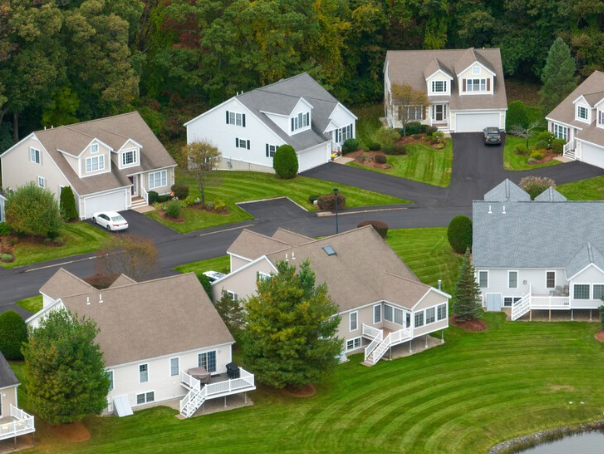
Almost everyone loves the look of a perfectly manicured lawn.
The neat, bright green of the grass and the well-kept bushes seem to speak to the minds of HOA presidents and residents alike. For many neighbors, it's an unspoken competition to have the greenest grass and the brightest flowers.
But underneath its beautiful exterior, the front lawn has dark secrets. Invasive species, excessive water usage, and habitat destruction are just some of the things hidden under the bright green umbrella of the suburban lawn.
So let's take a look at exactly how your lawn fits into the environment.
Excessive Water Usage
This is the problem you're probably most familiar with.
Depending on where you live, you might be used to getting alerts telling you to avoid watering your lawn when there's a drought.
That's because around 30% of the average homeowner's daily water usage is outside, and much of that is just for plant irrigation.
However, not all of this water is being used efficiently. Much of it is wasted because of evaporation, wind, and improper runoff techniques. Oftentimes your lawn might not need to be watered.
One way to determine if a lawn is actually in need of irrigation is by pressing your foot into the grass. If it quickly bounces back, it doesn't need more water.
If you're looking to make your systems more efficient, find certified professionals who specialize in the subject. This will save you not only water, but money as well!
Water uses a lot of energy, so by reducing wastage, you're significantly reducing your own carbon footprint.
Native Plants and Monocultures
Invasive species are one of the many problems facing the environment. Invasive species are non-native plants or animals that have been introduced to an environment they don't belong in, to the detriment of that environment. They are part of the reason why many countries have rules about bringing in outside produce.
Invasive plant species can choke out native plants that provide habitats and food to local animal species. Unfortunately, lawns are a big part of this problem.
Much of the grass and plants used in front lawns are non-native, and many of them are considered invasive. While it might seem that they're contained to your yard, it's surprisingly easy for plants to spread. Whether it be by the wind or even large underground root systems, nothing is fully contained by your yard.
The use of non-native plant species in lawns creates large monocultures. The term monoculture typically refers to the agricultural practice of growing only one or two types of crops in a large area, but it's used in this context because the same effects are taking place. By planting so few native plants in lawns, there are large swaths of land where the usual rich environment is not functioning properly.
But the solution for this specific issue isn't all that complicated. It's actually pretty simple. All you have to do to make your lawn healthy for the environment is use as many native plants as possible. There are hundreds of resources online to find out what plants are native to your area.
Making your lawn healthier for the environment also has added benefits for you. Native plants are better suited for their natural habitats. This means they often require less water than alien species. For fans of birds and pollinators, native plants often attract much larger numbers because they provide more resources.
So… What's Next for My Lawn?
Chances are that, right now, your lawn is not very good for the environment. You might be wasting water and overpaying as a result. Your plants could be non-native and subsequently creating a large monoculture.
But this doesn't mean you can't have a nice front yard. When people talk about rewilding our suburbs, the image of an unkempt lawn with grass up to your knees often comes to mind. This isn't exactly what conservationists are asking for, regardless of whether that is technically the best option.
By simply using native plants, you are already significantly improving the health of your local environment. Native plants can look just like the ones you might be used to, bright and flowering or bushy and well controlled. Your yard can still win best yard of the month for a year straight.
This is a situation where one person really does make a difference. If just you out of your whole neighborhood change your plants and make your water use more efficient, you are truly helping your local environment. One person can provide an oasis in the middle of what is essentially a desert for many animals.
When you're doing all this, you're also improving your carbon footprint and helping our world. Energy efficiency is one of the easiest ways for the average person to help with climate change, and by improving your efficiency with your lawn, you're also helping your local animal species.
So go out to your local plant nursery and look at your water systems. Talk to your neighbors and even your HOA (if you have one). You can make a difference in your community, so use this as a starting point for making the world a better place.
References
Audubon. (2017, May 18). Why native plants matter. National Audubon Society. https://www.audubon.org/content/why-native-plants-matter
DiDomenico, N. (2023). Your yard, invaded. U.S. Fish and Wildlife Service. https://www.fws.gov/story/your-yard-invaded
EPA. (n.d.). EPA WaterSense | What is water efficiency | Water use & conservation. Retrieved September 2, 2026, from https://19january2017snapshot.epa.gov/www3/watersense/our_water/why_water_efficiency.html
Florian, M.-C. (2024, October 3). The lawn as battleground: How domestic landscaping became a symbol of American identity. ArchDaily. https://www.archdaily.com/1021933/the-lawn-as-battleground-how-domestic-landscaping-became-a-symbol-of-american-identity
Marshall. (2023, April 14). The lawn is an invasive species. The Long Island Conservation Alliance. https://longislandconservationalliance.org/2023/04/14/the-lawn-is-an-invasive-species/
Planet Wild. (2023, May 22). Understanding monocultures and "green deserts". Planetwild.com. https://planetwild.com/blog/monoculture-green-deserts-and-5-ways-you-can-help
Earth Rangers. (2014, March 9). Ten of the world's most invasive species. Earth Rangers. https://www.earthrangers.com/EN/CA/top-10/ten-of-the-worlds-most-invasive-species/
U.S. Department of Agriculture. (2019). What are invasive species? USDA National Invasive Species Information Center. https://www.invasivespeciesinfo.gov/what-are-invasive-species
US EPA. (2019). US outdoor water use | WaterSense | US EPA. https://19january2017snapshot.epa.gov/www3/watersense/pubs/outdoor.html