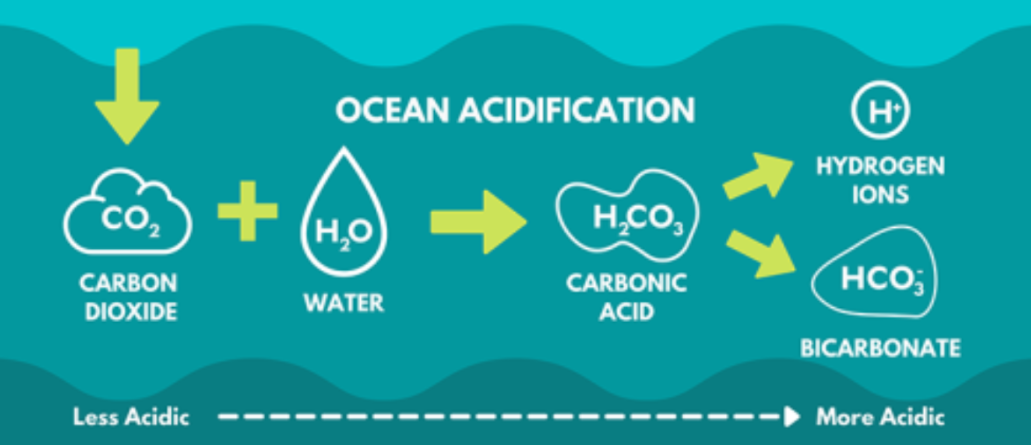
If carbon dioxide helps plants grow on land, why does increasing carbon dioxide in the ocean create such serious problems for marine life? Ocean acidification is the ongoing decrease in the pH of Earth's oceans. This happens when excess carbon dioxide (CO₂) from the atmosphere dissolves into surface ocean water and reacts with seawater to form carbonic acid (H₂CO₃).
Carbonic acid then breaks apart, or "dissociates," into hydrogen ions (H⁺) and bicarbonate ions (HCO₃⁻). The extra hydrogen ions react with carbonate ions (CO₃²⁻) already present in the water, forming even more bicarbonate ions. As a result, the amount of carbonate available in the ocean decreases.
This is a major problem because carbonate ions combine with calcium to create calcium carbonate, the main material used by many marine organisms to build shells and skeletons. Even a small decrease of 0.4 pH units could reduce carbonate ion levels by about 50%, making it much harder for organisms such as corals, oysters, and some plankton to form and maintain their structures. The collapse of coral reefs, shellfish populations, or key plankton species could trigger cascading effects — disrupting everything from fish populations to marine mammals and seabirds. The loss of coral, oyster, and mussel reefs also makes shorelines more vulnerable to floods and erosion. About one billion people are wholly or partially dependent on fishing, tourism, and coastal management services provided by coral reefs. By the end of the century, annual clam supplies could decrease 35%, oysters 50%, and scallops 55% if emissions continue unabated.
Carbon dioxide emissions from human activities are the primary cause, with atmospheric CO₂ levels exceeding 422 ppm as of 2024. Each year the ocean absorbs about 25% of all the extra CO₂ emitted; over the last few hundred years, about 30% of all extra CO₂ humans have added to the atmosphere has percolated into the oceans.
The only solution that addresses the root cause is reducing CO₂ emissions which is one of the main objectives of climate change mitigation. While scientists are exploring ways to restore reefs and breed more resilient shellfish, these efforts can only slow the damage if carbon emissions continue to rise. Protecting the ocean ultimately means limiting the amount of carbon dioxide entering the atmosphere in the first place. Addressing this issue requires action at every level, from supporting clean energy and policies that reduce greenhouse gas emissions to making everyday choices that lower our own carbon footprint. By reducing emissions today, we can help preserve coral reefs and the countless species that depend on them for generations to come.
References
National Oceanic and Atmospheric Administration. (2024, June 16). What is ocean acidification? National Ocean Service. https://oceanservice.noaa.gov/facts/acidification.html
Smithsonian Institution. (n.d.). Ocean acidification. Smithsonian Ocean. https://ocean.si.edu/ocean-life/invertebrates/ocean-acidification
Intergovernmental Panel on Climate Change. (2023). Climate change 2023: AR6 synthesis report. https://www.ipcc.ch/report/ar6/syr/