Why Does Plant Chemistry Matter in a Warming World?
Plants are a major part of our ecosystem. They absorb CO₂ and release O₂, which is crucial for the survival of life on Earth. In the past five decades, this ecosystem has been degrading consistently because of harmful human activities.
The change in a plant's mechanisms is not just a “plant problem.” Plants are the foundation of the ecosystem, and if they are in a crisis, we're in a bigger one.
Effect of Global Warming on Plants
1. The CO₂ Loop
One of the most common causes of global warming is elevated CO₂ emissions. Cars, industries, machines — everything contributes to carbon emissions in the modern world. Global warming is engraved into the system, therefore a carbon cycle imbalance is expected.
Plants also contribute to this imbalance. Earlier, plants used to have balanced respiration and photosynthesis rates, but with high temperatures and a warming climate, one of the beneficial features of plants has backpedaled for its own survival — the carbon cycle.
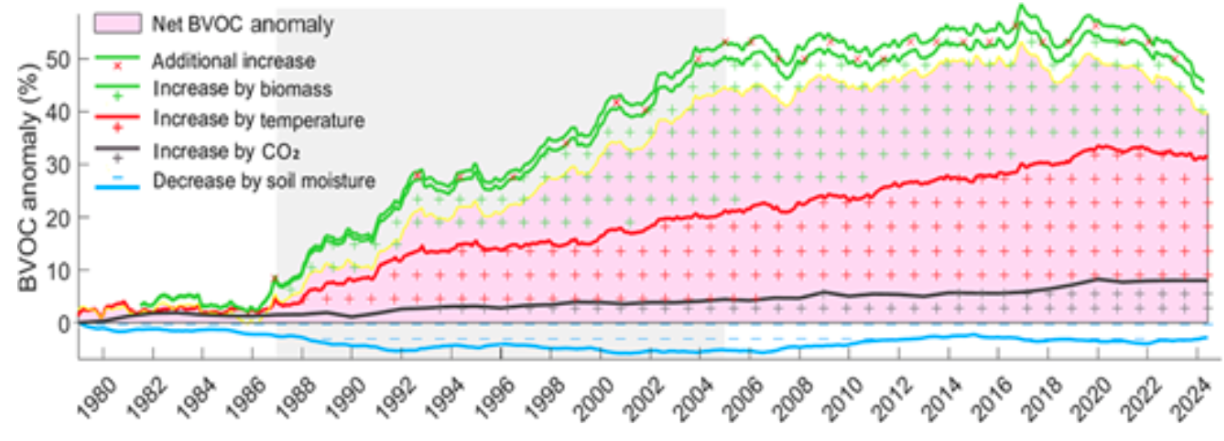
Elevated CO₂ has two opposing effects:
- Positive: more biomass and leaf area → more total BVOCs at the ecosystem scale.
- Negative: direct physiological inhibition of emission per leaf area for some compounds (e.g., isoprene, some monoterpenes) under very high CO₂.
Now, plants absorb CO₂ from the air, as usual, for photosynthesis, but due to high temperatures, the respiration rate of plants has increased and more carbon is being released than absorbed into the environment.
Plants break down stored carbohydrates for energy because they are in a hyper-metabolic state even during nighttime. This is due to light pollution — light triggers the phytochromes to maintain the hyper-metabolic state like in daylight (for photosynthesis) — which requires excessive energy. This process releases CO₂ back into the air. It forms a loop which leads to a carbon imbalance in the environment.
2. Secondary Metabolites
Due to extreme heat, plants undergo intense thermal stress. This leads to the formation of specialised compounds which are emitted by the plant to act as coolants.
A large meta-analysis of medicinal and aromatic plants finds:
- Elevated CO₂ tends to increase phenolics and terpenoids.
- Elevated temperature especially increases phenolic compounds.
- Drought (decreased precipitation) promotes all major classes of secondary metabolites.
- Nitrogen deposition has mixed effects (e.g., increases alkaloids, can decrease phenolics/terpenoids).
Major secondary metabolites released into the atmosphere:
Biogenic Volatile Organic Compounds (BVOCs): They are released to relieve stress as they act as coolants, but they do not play a major role in respiration or photosynthesis. They often degrade the atmosphere by reacting with ozone and free radicals in the air to form secondary organic aerosols (SOAs). These SOAs affect the atmospheric layers and light dispersion. Higher CO₂ emissions increase total BVOC emissions.
Phenolics, terpenoids, and alkaloids: Higher temperatures stimulate the carbon-based metabolic pathways. Increased thermal stress and water deficit expand the production of phenolic compounds, BVOCs, and oxidative stress on the plant.
When plants are under high heat stress, they release BVOCs, terpenoids, phenolics, and other compounds called thermoprotective compounds.
3. Droughts
As mentioned earlier, droughts stimulate secondary metabolism as a defense response to counter thermal stress. Hence, plants produce secondary metabolites.
Additionally, due to extreme heat in the environment, plants go into survival mode. They close their stomata to prevent transpiration. But since stomata are also responsible for the exchange of gases, absorption of CO₂ is reduced. This makes the plant a weak carbon sink.
Different climate factors trigger different chemical responses in plants. This makes predictability less accurate, leading to non-uniformity in the resultant changes in plants.
In other words, combined stress from heat, drought, and ozone can produce a response that cannot be predicted by adding the effects of each factor individually. The effects of global warming are species-specific and environmentally dependent in plant chemistry.
References
Columbia Climate School. (2022, January 27). How climate change will affect plants. State of the Planet. https://news.climate.columbia.edu/2022/01/27/how-climate-change-will-affect-plants/
Dusenge, M. E., Duarte, A. G., & Way, D. A. (2019). Plant carbon metabolism and climate change: Elevated CO₂ and temperature impacts on photosynthesis, photorespiration and respiration. New Phytologist, 221(1), 32–49. https://doi.org/10.1111/nph.15283
Loreto, F., & Schnitzler, J.-P. (2010). Abiotic stresses and induced BVOCs. Trends in Plant Science, 15(4), 200–208. https://doi.org/10.1016/j.tplants.2010.01.006
Oumami, S. (2024). Impact of a +2°C climate on the emission of biogenic volatile organic compounds and on air quality [Doctoral thesis, Aix-Marseille Université]. HAL. https://theses.hal.science/tel-04503172v1/file/OUMAMI_Safae.pdf
Peñuelas, J., & Llusià, J. (2001). Responses of plants to heat waves and high temperatures. In Plant physiological ecology (pp. 345–363). Springer. https://doi.org/10.1007/978-94-017-2704-4_12
Zhang, Y., Liu, X., & Wang, M. (2022). Plant secondary metabolic responses to global climate change: A meta-analysis in medicinal and aromatic plants. Global Change Biology, 28(24), 7321–7335. https://doi.org/10.1111/gcb.16484