This past summer there's been a lot of talk about climate change and where it's going. With much of the world experiencing extended heat waves and more severe weather events, many are asking what's coming next.
Earlier this year, the UNEP (the UN Environment Programme) released a report detailing some updated predictions for the climate. Across the board, there were a lot of different conversations about this report, but one of the most common questions seemed to be: how do they even know this?
So let's take a look at what the current predictions for the climate are, and how experts are making them.
The Future of the Climate
You might have heard various phrases surrounding the number "1.5".
This comes from the Paris Agreement, a legally binding international treaty adopted by 195 countries in 2015. It set the goal of preventing excess warming of the climate beyond 1.5 degrees Celsius.
The global average surface temperature indicates the Earth's energy balance. Think of it as the amount of sunlight the Earth absorbs minus the amount of heat it radiates back into space. When these two amounts are equal, things are balanced, but when they're not, the Earth gets cooler or warmer.
Since the Industrial Revolution, the average surface temperature has risen over 1 degree Celsius. It sounds small, but it indicates a very large overall change in a relatively short amount of time. It takes an incredibly large amount of heat energy being added to the Earth to raise the temperature even slightly.
The Paris Agreement stated that countries would limit the amount of heat increase to 1.5 or below (it's important to remember that monthly or annual breaches of 1.5 degrees in excess heating don't mean the agreement has failed). Even at our current levels of global warming, we are already seeing the effects. Intense extreme weather events are becoming more common, glaciers are melting at high rates, and coral is being bleached.
However, at 1.5 degrees Celsius of excess warming, the consequences will be worse. Coral reefs will face almost complete destruction, storms we think of as "unheard of" will become commonplace, and melting ice will cause increasing floods. There are almost certainly more issues that we won't know of until they happen.
The world is currently forecasted to pass the 1.5 threshold by around 2030. New predictions state that the world will not surpass 1.8 degrees, but that we probably will not be able to avoid passing 1.5.
How the Predictions Are Made
All the numbers and information above might be overwhelming, and you're probably wondering how they were found in the first place.
Global climate models are extremely complex computer programs with hundreds of thousands of lines of code. They don't predict the weather (daily or hourly experiences in an area); they predict the climate (the average weather over a long period of time).
Scientific models explain how a system of interacting and interrelating elements works by using mathematical relationships and equations. Mathematical relationships can explain how the system might respond to things in the future.
Take the scientific model of evaporation as an example. The sun heats water, the energy is then transferred to water molecules, and the result is water evaporating. When scientists look at this process, they use observable and predictable patterns that have been translated into equations. Those equations are then made into larger models that can model the process with other conditions in place.
Now, the climate models used to make predictions for the future are far more complex than the above example. There are dozens of different factors that play into predictions.
It's more challenging to make climate models than most other scientific models, a result of the complexity of Earth and its size.
What Climate Models Tell Us
Climate models don't just tell us how much the Earth is going to warm up in the future. They can tell us how different factors will speed it up or slow it down and how the heating will affect different aspects of the world (the ocean, the atmosphere, local areas, etc.).
Of course, all scientific models have a certain level of uncertainty. Our world is incredibly complex, and it's difficult for scientists to include every possible thing that could affect the outcome. However, climate models are widely considered to be very accurate. There are thousands of people who spend their professional careers working on these models. As time goes on, they get more and more accurate. They will continue to improve as the computing power and information we have also improve.
As depressing as our current climate predictions can be, keep in mind that there are things you can do to make it better. Simple things like reducing your energy usage by keeping only essential lights on, making sure your water systems are efficient, and reducing your food waste. Our world may be headed towards a more dangerous place, but if we all work together, it is more than possible for us to avoid worst-case scenarios.
References
Lindsey, R., & Dahlman, L. (2025, May 29). Climate change: Global temperature. NOAA Climate.gov. https://www.climate.gov/news-features/understanding-climate/climate-change-global-temperature
United Nations Environment Programme. (2026, September 2). UNEP: World set to cross 1.5°C global warming, but can still limit, adapt to and return from higher temperatures. https://www.unep.org/news-and-stories/press-release/unep-world-set-cross-15degc-global-warming-can-still-limit-adapt-and
Sommer, L. (2021, November 8). This is what the world looks like if we pass the crucial 1.5-degree climate threshold. NPR. https://www.npr.org/2021/11/08/1052198840/1-5-degrees-warming-climate-change
The rapid approach of the 1.5°C global warming threshold since the Paris Agreement. (2020). Copernicus. https://climate.copernicus.eu/rapid-approach-15degc-global-warming-threshold-paris-agreement
United Nations. (2025). 1.5°C: What it means and why it matters. https://www.un.org/en/climatechange/science/climate-issues/degrees-matter
USDA. (n.d.). Basics of global climate models | USDA Climate Hubs. Retrieved September 25, 2026, from https://www.climatehubs.usda.gov/hubs/northwest/topic/basics-global-climate-models
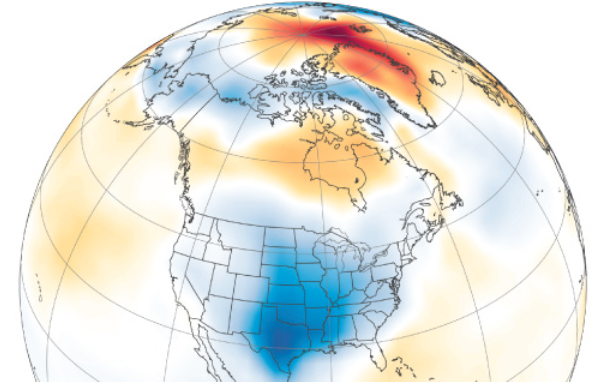
Banner image credit: Lindsey, R. (2021, March 5). Understanding the Arctic polar vortex. NOAA Climate.gov. https://www.climate.gov/news-features/understanding-climate/understanding-arctic-polar-vortex