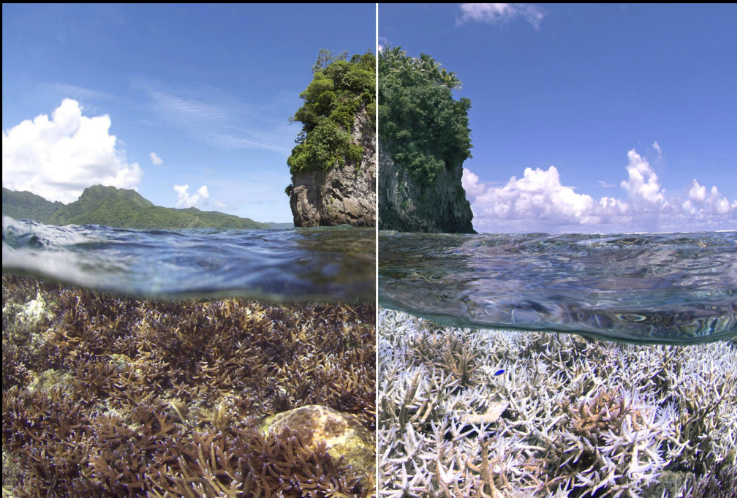
Bleaching (white) coral isn't dead. But the worse part? It's starving, and it will die unless we do something to stop the rapid ocean warming. In this article, we'll explore how coral reefs are affected by ocean warming and climate change, and an innovative idea discovered by Steve Palumbi, a Stanford professor of oceans, and his team on the limits of conventional reef restoration.
What's happening to our corals?
Like I said, bleaching coral reefs aren't yet dead — they're starving.
Each polyp (the singular of coral reef) has cells, and within those cells live the algae that give corals their vibrant color. But what you may not know is that those algae also provide the polyps with food (think of them like chloroplasts — they use photosynthesis to provide nutrients to the organism).
However, the rapid ocean warming is making temperatures too hot for algae to survive in the polyps' cells. So the cells have only one thing left to do: expel the algae. However, this means that the organism just lost its only way to get food — so it starves.
But what we don't realize is that if we can lower the temperatures, our vulnerable coral reefs will come back. The algae will return to the cells, and the polyps will have food after all.
Nature has given us a second chance to undo our actions, for the coral reef ecosystems to return to the way they once were. Will we take that chance?
Why are corals important anyways?
But before we come up with any solutions, we first must understand why coral reefs are so important to ecosystems anyways.
Healthy reefs lessen flooding and damage from coastal storms. In fact, they've saved over 1.8 billion dollars each year in the US in averted coastal flood damages and property losses.
They also serve as nurseries for endangered animal species, such as sea turtles, and provide homes for valuable fish that people eat.
One innovative idea . . .
"Show me a square mile of reef that has been [successfully] restored. There isn't one," says Steve Palumbi.
Finding solutions to stop coral bleaching is . . . to say the least, hard. But this isn't JUST because it's hard to stop the rapid ocean warming (the main problem), but because the places that rely on coral reefs the most (like the remote island of Palau) don't have enough resources, money, or time to help restore their reefs in an efficient way.
Although many people are realizing that coral reef restoration is important and are investing in it, the methods people are using right now, well . . . don't really work.
Time and money are spent carefully rebuilding populations of corals under lab conditions, but when they are added back into the ocean, most, if not all, still die, because replenishing the population isn't enough. The temperatures are still too high.
But Steve and his team have figured out an inexpensive way to identify corals that may tolerate warming waters. And they're using . . . picnic coolers.
Using picnic coolers, they've devised an experiment that mimics real-life ocean warming conditions (including temperature changes from high and low tides). Taking picnic coolers, they've added heat pumps and warm water, so the temperature of the water inside is easily changeable.
They set the baseline temperature to the highest temperature the water gets on an average day. They would start with 30 degrees and increase the temperature by 1 degree each day (the first day would increase to 34 degrees, then 35 the next day, and so on).
After a few days of testing different species of coral, and rating them based on color (how bleached the coral is), they were able to figure out which species could tolerate more heat*. The species that could are more likely to survive the actual heat stress of the ocean, and are more likely to still be around in the future.
The hope is that by cross-breeding corals of higher heat tolerance, we can repopulate corals in a more efficient way, ensuring they have a higher likelihood of survival.
But, of course, this solution does not really "solve" coral reef decline. It's a start to making sure coral reefs are still around in the future, because their existence is critical to the health of marine ecosystems.
This solution does have its downsides, but it's cheap and efficient, and it may be what we need right now.
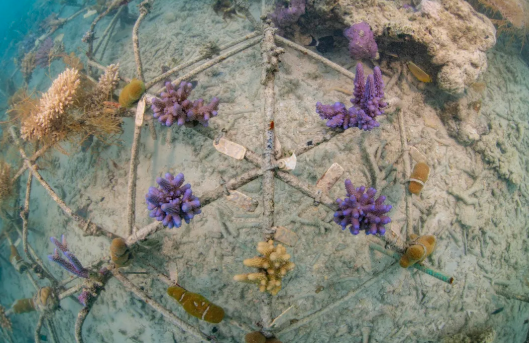
* Like height in humans, heat tolerance is a factor that varies from species to species, but also individual to individual. So by mating polyps with higher heat tolerance, there's a higher chance that the offspring will also inherit that quality. (It's like if you have tall parents, you are likely to grow tall yourself.)
References
Jones, B. (2026, August 17). Inside the race to buy coral reefs more time. Vox. https://www.vox.com/climate/497730/coral-reef-climate-change-restoration-palau
Banner image credit: Climate.gov