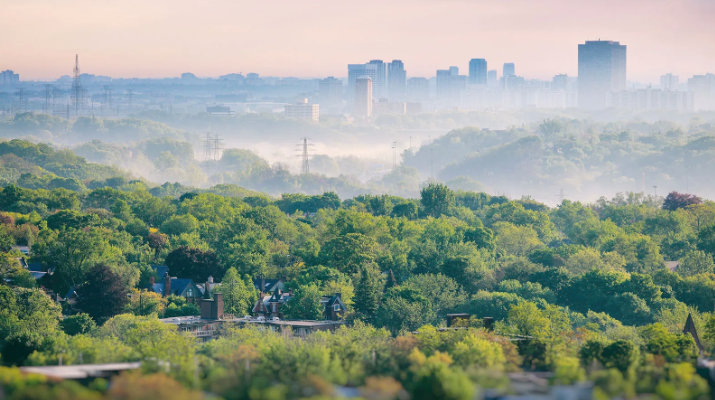
What if trees followed money?
"Money doesn't grow on trees" is a common idiom I hear, and indeed money does not grow on trees. But what if trees grew only where money was? That's what we observe nowadays.
If you look up a map of a city, it is divided into two parts mainly — the green and the non-green part. Many studies found that trees were usually found in rich neighbourhoods, while the poor ones were surrounded by black asphalt and concrete, even in developed countries like the US. Many developing countries and underdeveloped ones are still not able to provide concrete housing to their population. This difference in tree canopies is called the TREE EQUITY GAP.
Trees aren't just aesthetically pleasing. They also contribute as one of the factors to the temperature difference between rich and poor neighbourhoods. The former is cooler, as the tree canopies give a cooling effect through evapotranspiration throughout the day. On the other hand, black asphalt acts as an energy warehouse — storing solar energy during the daytime and radiating it back at night, heating up the surrounding poor households. Satellite thermal imaging reveals that land surface temperatures in zero-canopy, low-income districts can spike up to 10°C to 15°C higher than green, affluent neighborhoods within the exact same municipal boundaries.
The global data
Many peer-reviewed studies confirm that while tree cover mitigates nearly half of potential urban heat island effects, those cooling benefits are disproportionately concentrated in high-income zones. This can be supported by the fact that suburban neighbourhoods have a high 40–50% tree canopy cover, whereas lower-income neighbourhoods hover around 5–10% tree canopy cover.
Lower-income neighbourhoods usually comprise the working-class population. It wouldn't be wrong to infer that they are accustomed to high thermal stress due to the lesser tree cover in their surroundings. Tree canopies reduce Wet Bulb Globe Temperature — the global metric for measuring heat stress on human physiology — three times more than a simple shade structure. Depriving the working class of an appropriate environment increases thermal stress on those who rely on public transit or walking for work.
How did we end up like this?
The modern shade gap is the direct legacy of stereotyped urban planning and industrial zoning. Cities didn't magically grow this way.
Throughout the 20th century, redlined and marginalized neighbourhoods were the dumping grounds for society. From industrial parks and asphalt highways to concrete buildings for multi-family accommodation, everything was subjected to these neighbourhoods. The natural topsoil was eroded and stripped off, leaving zero soil footprint for root systems to take hold. While the rich thrived in cool surroundings and high oxygen, the poor dealt with the aftermath of the pleasures of the rich (as usual…).
Even today, the system remains the same. Public departments routinely prioritise tree maintenance, pest management, and park expansion in wealthy zip codes where homeowners lobby loudly for property "aesthetics". Meanwhile, working-class urban areas are treated as places designed to move cars and store infrastructure rather than sustainable living biomes.
The divide has not been fixed at all, and why would it be? It's convenient as it is now for those in power. But we should ask the question, if it hasn't been asked yet: is a basic necessity like having shade overhead also a privilege denied to poor households? What to make of the fact that the working class, who work the most, are the ones who do not get a sliver of shade over their heads while returning from work, whereas the rich — driving cars — do not even care about the tree cover other than for their aesthetically pleasing view?
The health tax of this neglect is severe. Living in a low- to no-canopy zone, there are possibilities of higher rates of heat stroke, aggravated childhood asthma (stagnant, unshaded air can trap particulate pollution), and soaring electricity bills for low-income families who are forced to run fans and ACs (if they have any) continuously to escape the extreme heat in uninsulated housing.
What is the solution?
The first thing one would think of is: just plant more trees in low-income neighbourhoods. And that is exactly what should be done, so remind me again why it still hasn't been implemented yet. (Insert a heavy sigh at income-level gaps here.)
It's time we stop taking trees as mere 'decorations' or a luxury only for rich neighbourhoods.
Urban tree canopies are life-saving and essential for public health. Just like clean drinking water pipes, electrical grids, or sewage systems, tree canopies are a basic necessity as well. Denying a neighbourhood green cover while climate extremes escalate is a form of structural eco-classism.
Solving the thermal divide requires treating tree planting as an urgent equity intervention. Municipalities must redirect forestry budgets toward "Tree Equity" models, prioritizing high-density, asphalt-heavy blocks first.
A city's blueprint shouldn't dictate who gets to breathe cool air and who bakes on the pavement. Shade shouldn't be a privilege of class; it's a basic requirement for survival in the modern city.
References
McDonald, R. (2021, April 28). Mapping tree cover disparity. Cool Green Science. https://blog.nature.org/2021/04/28/mapping-tree-cover-disparity/
American Forests. (2021). Tree Equity Score: Methodology and socioeconomic correlates of urban forest cover. TreeEquityScore.org. https://www.americanforests.org/tools-research-reports-and-guides/tree-equity-score/
McDonald, R. I., Chakraborty, T., Endreny, T. A., et al. (2026). Trees halve urban heat island effect globally but unequal benefits only modestly mitigate climate-change warming. Nature Communications, 17, 3569. https://doi.org/10.1038/s41467-026-71825-x