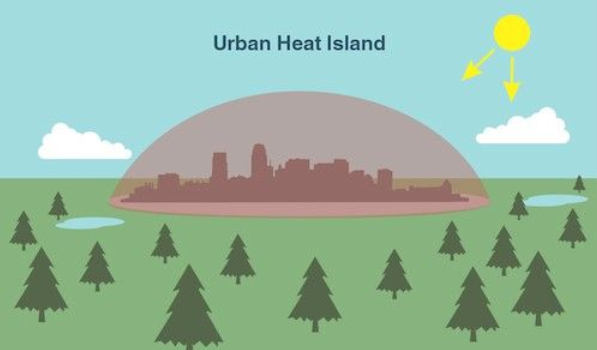
What is the urban heat island effect?
The very definition of urban heat island originated from the phenomenon of cities heating up more than their nearby rural areas. Hence, cities being called an urban heat island is a default. But what made humans make a new phrase to describe this phenomenon?
Urban planning has played a major role in how cities are now a 'heating island'. Overlooking the ecological impacts and striving to boost the economic value of a city resulted in a whole new phrase invention (splendid! What's the learning here, class?).
Types of urban heat island effects
Since there is a difference between the surface temperature of the earth and the atmospheric air temperature, heat islands are categorized into two types:
- Surface heat islands: Urban surfaces such as roadways and rooftops absorb and emit heat to a greater extent than most natural surfaces, which leads to higher temperatures — forming surface heat islands. They are much more intense than atmospheric heat islands when the sun is shining.
- Atmospheric heat islands: The warmer air difference between urban (higher) and rural (lower) areas leads to the formation of these islands, which are comparatively less intense than surface heat islands.
Causes of the urban heat island effect
- Natural landscape depletion: Vegetation helps provide shade and increase transpiration — giving a cooling effect — and water bodies increase surface water evaporation. Therefore, when an urban area is deprived of them, the relatively higher temperature observed nowadays is understandable.
- Infrastructure properties: The buildings in urban areas are made to be aesthetically pleasing and cost-effective. Materials such as asphalt and concrete and minimalistic color patterns (dark color palettes) make buildings absorb more of the sun's heat and reflect less solar energy. This is also why cities are observed to be warmer at night than in the daytime, because the release of heat from the surfaces is a slow process.
- Dense architectural accommodation: We all have seen chains of long buildings in metropolitan cities (ring a bell?). Yep, so that's the problem here. The chain of buildings does not have enough gap between them, restricting airflow. Even when the surface re-radiates the heat energy, due to the narrow gap, most of it gets reabsorbed by the nearby infrastructure. Therefore, higher temperatures at night, which may end up ruining your sleep schedule (if it isn't already) due to elevated cortisol levels.
- Human activities (obviously it's here too): You turn on your AC because it's too hot outside. Well, guess what? It's gonna be hotter, because your precious AC — while bringing relief to you — contributes to this effect of warming up the city even more (a loop is what it is!). So any waste heat produced by humans or anthropogenic activities adds to ambient temperatures, particularly in heavily populated or high-traffic areas.
Understanding the urban heat island effect
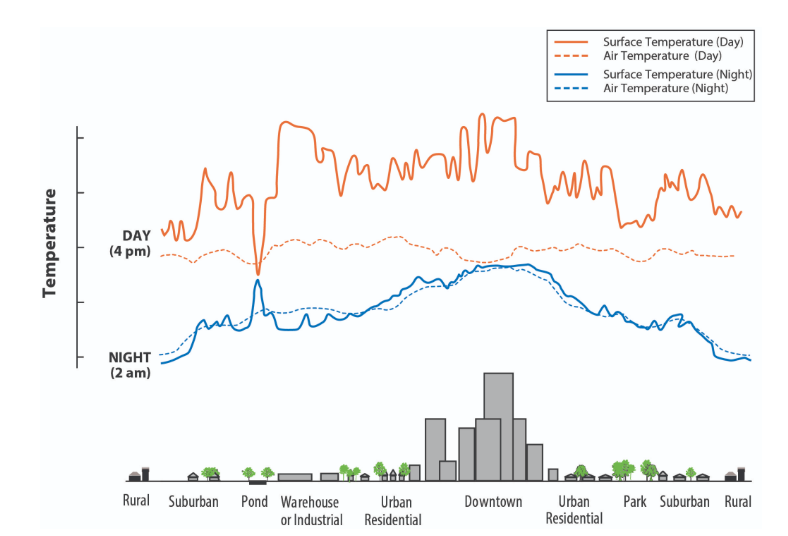
According to the graph above, the effect of the urban heat island is just like what we discussed. It is mostly consistent, except for the sudden drop in daytime temperature and increase in nighttime temperature around ponds. A slight thermal buffer at night is due to water's heat retention property, which is not the same as surfaces' heat radiation. As water bodies increase surface water evaporation, even with the sun overhead, the temperature around the pond didn't increase. Unlike buildings and roads, ponds don't absorb solar energy in the daytime and therefore create cooler air and a cooler environment around them. Similar explanations can be given for the dip in daytime temperature around parks as depicted in the graph. The spike in nighttime temperature downtown can be explained by the dense architectural patterns seen in the city. In conclusion, the urban heat island effect isn't a minor or limited phenomenon seen in just a few cities. This effect has been observed in 400 major cities worldwide.
The impacts of the urban heat island effect on people
- Cardiovascular and respiratory stress: Due to elevated temperatures, the heat stress at night is nearly similar to the one we face under the sun during the daytime. So even when you're not working overtime, your heart is, and that's why chronic cardiovascular diseases, heat stroke, and heat exhaustion are more frequent among the public in urban areas than in rural sectors.
- Energy overconsumption: Increased use of ACs for cooling due to heat consumes more energy, which drives the urban heat island effect further. This feedback loop raises the risk of power outages and puts pressure on energy grids. The high demand leads to high costs, which limits the accessibility of cooling apparatus for the common public — more stress (heat and finance, both!).
- Urban planning loophole: Lower-income neighbourhoods usually have fewer trees around them and more asphalt in their surroundings, which creates thermal and social inequality. This can also cause a higher percentage of observed heat-related diseases in these neighbourhoods than in high-income ones.
Climate change as a catalyst
The impact of climate change is basically the increase in baseline temperature and heat wave intensity, which is a positive contributor to the urban heat island effect in cities. This amplifies the overall effect, which is compounded when these two come together. Urbanisation degrades environmental and public health systems while climate change heats up the already warm surroundings.
Solutions
We have understood the seriousness of the issue, but every problem has a solution, so here are some measures that can be adopted to lessen the urban heat island effect in cities:
- Afforestation (obviously. Seriously, how many things can be mediated by afforestation alone, to an extent? But are we doing the apparent things? Yep, you got it! NO!)
- Use cool infrastructure during urban planning (maybe renovation is overdue?).
- Spread awareness to create communities and programs which adapt and regulate cooling systems on a local level.
- Better urban planning which balances the ecological and economic aspects of a city sustainably.
References
Heat Islands | United States Environmental Protection Agency. https://www.epa.gov/heatislands
How the Urban Heat Island Effect Affects Our Communities | Texas A&M University, School of Public Health. https://public-health.tamu.edu/degrees/mph/blog/environmental/how-the-urban-heat-island-effect-affects-our-communities.html
What is an Urban Heat Island | NASA Science. https://science.nasa.gov/kids/earth/what-is-an-urban-heat-island/
Banner image credit: NASA Science