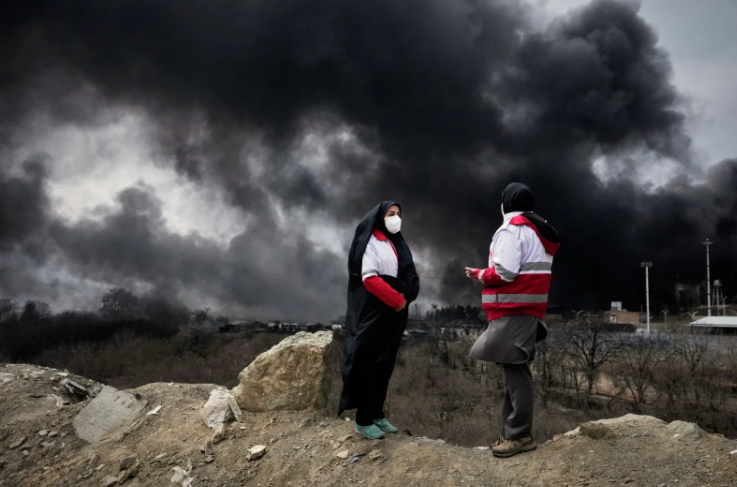
As the United States and Iran entered a period of renewed conflict under President Donald Trump, global attention has focused primarily on military strategy and political outcomes. Yet researchers and environmental experts warn that the consequences extend far beyond the battlefield. Strikes against energy infrastructure, industrial facilities, and essential services threaten to worsen Iran's existing struggles with water scarcity, pollution, and climate vulnerability.
A War Against More Than People: How Conflict Threatens Iran's Ecosystems
Iran entered this conflict already facing severe environmental challenges.
For years, the country has struggled with declining water availability, prolonged droughts, groundwater depletion, and rising temperatures linked to climate change. These pressures have affected agriculture, cities, and ecosystems across the country. Now, the war has added another layer of stress.
According to researchers at the Institute for International and Strategic Affairs (IRIS), conflict-related damage to oil facilities, industrial sites, and energy infrastructure has created additional risks for Iran's air and water systems. Anne Sénéquier, a researcher at IRIS, argues that modern wars no longer only destroy physical infrastructure but also disrupt the ecological systems that societies depend on.
Oil Facilities Have Become Primary Environmental Targets
One of the greatest environmental concerns comes from attacks on energy infrastructure.
Oil facilities are among the most strategically important targets in modern conflicts because they influence economies and military capabilities. However, when these facilities are damaged, they can release enormous amounts of pollution.
During the conflict in Iran, strikes on oil storage and industrial facilities created large smoke plumes containing pollutants such as nitrogen dioxide, sulfur dioxide, carbon monoxide, benzene, formaldehyde, and fine particulate matter. The Strait of Hormuz, where much of the recent conflict has centered, carries roughly one-fifth of the world's traded oil. Even limited attacks on commercial vessels or coastal energy infrastructure increase the risk of oil spills that threaten coral reefs, fisheries, mangrove ecosystems, and marine biodiversity throughout the Persian Gulf.
Can Laws of War Prevent Environmental Destruction?
International humanitarian law recognizes that the environment deserves protection during armed conflict.
Articles 35 and 55 of Additional Protocol I to the Geneva Conventions prohibit methods of warfare expected to cause "widespread, long-term, and severe damage" to the natural environment. The International Committee of the Red Cross (ICRC) has also published updated guidelines urging militaries to minimize environmental harm when planning and conducting military operations.
Yet enforcing these rules is extraordinarily difficult. Terms such as "widespread" and "long-term" lack precise legal definitions, making violations challenging to prove. Military necessity is often cited to justify attacks on energy infrastructure, even when environmental consequences are significant.
Recognizing these gaps, the International Law Commission adopted its Principles on Protection of the Environment in Relation to Armed Conflicts (PERAC) in 2022. Rather than focusing only on wartime conduct, the principles encourage governments to reduce environmental risks before conflict begins, limit ecological damage during hostilities, and prioritize environmental restoration once fighting ends.
The Environment Cannot Sign a Peace Treaty
A polluted river cannot be restored by a ceasefire. A damaged coastline does not heal when a treaty is signed. Communities living near contaminated land may continue facing the consequences long after the world has moved on to the next headline.
Governments must strengthen international agreements that hold nations accountable for environmental destruction, invest in technologies that monitor ecological damage during conflicts, and include environmental restoration as a necessary part of rebuilding after war. Organizations like the United Nations Environment Programme (UNEP), the International Committee of the Red Cross (ICRC), and environmental researchers around the world play a critical role in documenting damage and pushing for stronger protections.
Understanding this hidden cost changes the way we view conflict. Protecting nature is not separate from protecting people. A healthy environment is the foundation for communities to recover, rebuild, and survive.
References
International Committee of the Red Cross. (n.d.). The environment and warfare. ICRC. Retrieved July 10, 2026, from https://www.icrc.org/en/law-and-policy/environment-and-warfare
International Committee of the Red Cross and Red Crescent Movement. (1977). Protocol Additional to the Geneva Conventions of 12 August 1949, and relating to the Protection of Victims of International Armed Conflicts (Protocol I), 8 June 1977. https://ihl-databases.icrc.org/en/ihl-treaties/api-1977
International Law Commission. (2022). Principles on protection of the environment in relation to armed conflicts (PERAC). United Nations. https://legal.un.org/ilc/summaries/8_7.shtml
Sénéquier, A. (2026, April). The war in Iran: A conflict with lasting environmental and health consequences. Institut de Relations Internationales et Stratégiques (IRIS). https://www.iris-france.org/en/the-war-in-iran-a-conflict-with-lasting-environmental-and-health-consequences/