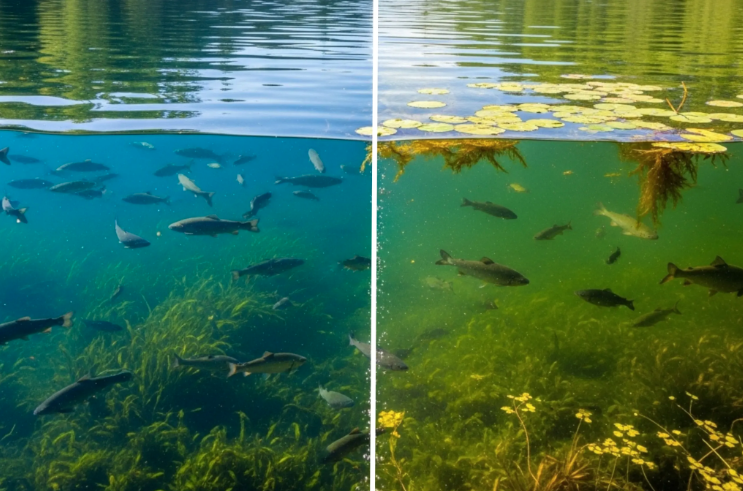
We'll dive into what water quality is, how water quality is measured, and what we can do to increase water quality.
Water Quality: What IS it?
Hard truth: NO water is completely pure.
But then, this raises an important question. Then what's the water we use for drinking, for showering, for cooking, for anything!? If that's not pure, then why are we using it at all?
Well, water quality is "a quantification of the ability of a water source to meet the chemical, biological, and physical requirements of a specific water use."
So, we don't need water to be "perfect". We just need it to be good enough. Good enough for our bodies to handle.
But the sad truth? Human actions, such as industrial waste, sewage, farming, and even doing laundry (I mean, think where all the dirty water goes) can lower the water quality.
And logically, this means more water pollution. And more water pollution means . . . well, the water quality will decrease.
And that ISN'T good, especially considering the fact that only about 2% of all water on Earth is "freshwater". And keep in mind that this 2% isn't just for us. It's split between animals, plants, us, (and the AI data centers).
So long story short? We CAN'T afford to pollute our water.
How do we measure water quality?
I mentioned earlier that water quality must meet chemical, biological, and physical requirements.
But what exactly are these requirements?
Turbidity
- Evaluates the "cloudiness" of the water
- Affected by small particles of suspended clays and silts, dissolved organic compounds, and microorganisms like algae and phytoplankton
- Lowers the amount of sunlight that reaches the bottom of the waterbody, which greatly affects marine life
- Higher turbidity caused by algal blooms can be toxic to humans and animals and decreases dissolved oxygen
- High turbidity can provide attachment sites for heavy metals and bacteria, causing water to get contaminated
Total Suspended Solids
- Measures the amount of insoluble particulate matter (basically anything over 2 microns in diameter)
- This increases the temperature of water
pH Level
- More acidic levels increase the solubility of metals in water (bad)
- Changes in pH can affect biodiversity, since some animals can only live at a certain pH level
Dissolved Oxygen
- More of it is good for marine animals, as oxygen is a vital resource for them. However, it causes corrosion, which dissolves plumbing pipes (and other pipes used to carry water).
Temperature
- When the water gets warmer, the rate of chemical reactions within it (such as the dissolving of rocks and sediments) increases. This increases the turbidity of the water.
- This can cause algae blooms, which contaminate water, as well as decrease the amount of oxygen available for marine animals.
- When the water is warmer it increases the metabolic rate of animals, causing them to require more resources, such as oxygen. However, when the water is TOO warm, the amount of dissolved oxygen in the water decreases, putting marine life in a tough situation.
Nitrogen and Phosphorus
- These elements are good for plant growth, but only in limited amounts. Excessive nitrogen and phosphorus cause algae blooms, which contaminate water, as well as decrease the amount of oxygen available for marine animals.
What YOU can do to improve water quality
According to the Environmental Protection Agency, these are things you can do to improve your water quality:
- Get informed. Find out about the water quality standards in your state, territory, or tribe.
- Participate in public events. Each time water quality standards are revised, the Clean Water Act requires states, territories, and authorized tribes to hold public hearings. The public may make recommendations on improvements or modifications to the standards during the public hearing process.
- Get involved. Participate in volunteer activities such as monitoring programs to help track the condition of your local rivers, streams, lakes, and other waters.
References
Federal Judicial Center. (2021). What is water quality? https://www.fjc.gov/content/376657/water-and-law-what-water-quality
Hogue, E. (2021, August). The importance of water quality. NOAA Office of National Marine Sanctuaries. https://sanctuaries.noaa.gov/news/aug21/water-quality-month.html
Denchak, M. (2023, January 11). Water pollution: Everything you need to know. NRDC. https://www.nrdc.org/stories/water-pollution-everything-you-need-know#categories
US EPA. (2014, June 24). Things you can do to protect water quality. https://www.epa.gov/wqs-tech/things-you-can-do-protect-water-quality
Banner image credit: H2O Global News