What Are BVOCs?
In the previous blog, we talked about the effect of global warming on plant respiration. One of the defense responses by plants as a means to cope with the physiological changes in the environment is the production of BVOCs, a coolant. They account for approximately 90% of all non-methane organic compounds in Earth's atmosphere — roughly 1 billion metric tons per year. Over 70% of global BVOCs are released from tropical forests due to dense canopy cover, warm temperatures, and intense solar radiation.
BVOCs are species-specific specialised compounds emitted by plants. They usually consist of isoprenes, monoterpenes, oxygenated VOCs, and sesquiterpenes. Around half of the total BVOC emissions is isoprene, with a leading 50–60% estimated share, followed by monoterpenes and oxygenated VOCs with 15–20% each. The remaining small contributors like GLVs make up around 3–4% of the total emissions.
Let's discuss what each of these BVOCs does and their effects on the environment.
Types of BVOCs
Isoprenes
- They are highly reactive compounds mostly emitted by broadleaf trees like oaks, poplars, and tropical species under sunlight and heat.
- They primarily react with OH radicals in daytime, ozone (O₃), and NOₓ.
- In high-NOₓ environments (usually cities and industrial regions), isoprenes react with OH to form peroxyl radicals (RO₂). Peroxyl radicals convert NO into NO₂, which sunlight breaks down to yield atomic oxygen, creating ground-level ozone (O₃).
- In low-NOₓ environments (tropical forests), isoprenes react with OH to form hydroperoxides (ISOPOOH), which consume atmospheric OH without forming ozone.
- Ground-level ozone is toxic to plants. It degrades chlorophyll, reduces photosynthetic efficiency, inhibits crop yields, and damages animal and human lung tissue.
- Since OH is an atmospheric “cleaner,” the exhausted local OH pools lengthen the atmospheric lifetime of other greenhouse gases like methane.
Monoterpenes & Sesquiterpenes
- Monoterpenes are heavily released by coniferous trees (pines, spruces) and citrus plants, as they are responsible for the pine-like forest scent.
- Sesquiterpenes are responses to plant stress (insect attacks, droughts).
- Both of them react with ozone, OH radicals, and NO₃ radicals rapidly as they contain double bonds (C=C).
- The carbon rings break open due to the reaction, and the oxygen binds with them to form extremely low volatility organic compounds (ELVOCs) and highly oxygenated organic molecules (HOMs).
- The ELVOCs and HOMs condense into microscopic airborne particles or cluster together to form secondary organic aerosols (SOAs).
- SOAs are both a boon and a bane to our environment. On one hand, they act as cloud condensation nuclei on which cloud droplets condense — more aerosols create brighter, denser clouds that reflect incoming sunlight back into space, producing a direct regional cooling effect. On the other hand, SOAs scatter sunlight and artificial light, amplifying artificial skyglow at night.
Oxygenated VOCs (OVOCs)
- They react with direct sunlight and OH radicals predominantly.
- Acetone and acetaldehyde are broken down into acetyl radicals by photolysis in the upper troposphere. These radicals combine with NO₂ to produce peroxyacetyl nitrate, aka PAN (CH₃C(O)OONO₂).
- PAN is thermally stable at cold, high altitudes. Wind transports PAN thousands of miles across the ocean to clean, remote ecosystems.
- BUT when the air descends and warms up (global warming), PAN decomposes back into NO₂, triggering ozone formation in areas that would otherwise remain pristine.
Human Activities Influencing BVOC Production
Human land use changes are one of the reasons for the significant rise in the acreage of high-emitting species. Due to deforestation, natural forest cover is declining in some regions, but commercial agroforestry and bioenergy production are heavily shifting global plant composition toward high-emitting monocultures:
- Over the past three decades, tropical rainforests in Southeast Asia, Central Africa, and South America have been converted into oil palm plantations. Oil palm isoprene fluxes are roughly 4–8 times per unit leaf area those of nearby rainforests, depending on the comparison and conditions.
- Due to the high demand for pulp, paper, and timber, fast-growing eucalyptus monocultures have been planted across South America, Southern Europe, Asia, and Africa.
- Poplar and willow bioenergy farms — releasing isoprene heavily — have been planted across North America and Europe to meet the growing demands for biomass energy and carbon offset projects.
These are just some examples of the many forests converted into commercial plantations that are causing severe harm to the environment. While cities are increasingly opting for low-BVOC trees like maples, lindens, and ashes to avoid urban ground-level ozone formation, at the global rural/industrial scale, high-emitting agricultural trees dominate land trends, hence disrupting the ecosystem.
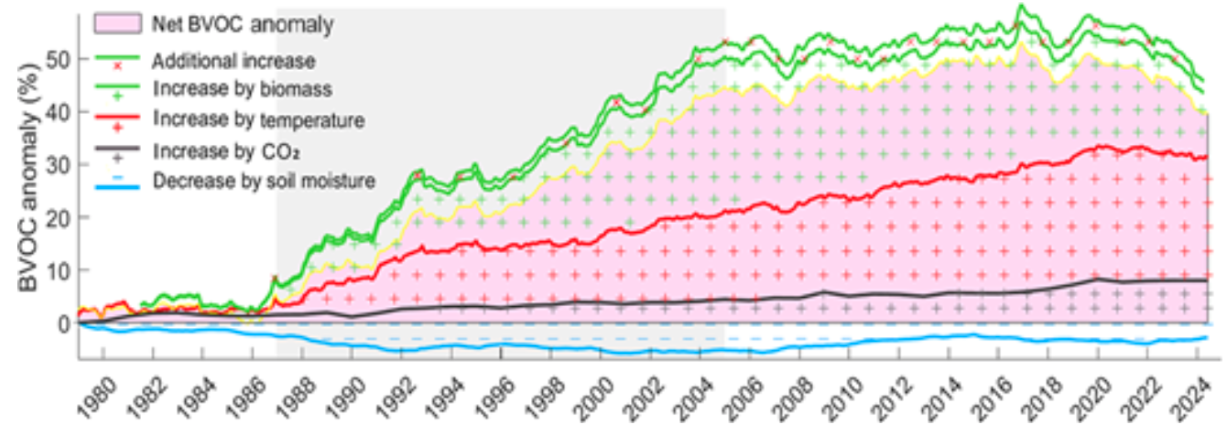
From the graph above, we can infer that global BVOC emissions have increased significantly. The two major contributors to this dramatic surge in BVOC emissions are global vegetation greening (increasing biomass) and rising global temperatures (global warming). A steady small positive driver, indicated by the black line, is the increase by CO₂ levels that fuels plant growth, indirectly boosting vegetation density (biomass).
Changing Roles of BVOCs
BVOCs were always considered one of the secondary factors that affect light pollution and compound its effect in the environment, primarily increasing artificial skyglow. They react with ozone, OH radicals, and nitrate radicals in the atmosphere to form SOAs, which increase Mie scattering of artificial light at night (ALAN). The amplified skyglow obscures ground-based optical astronomy and gives stars a hazy appearance in the sky.
BVOCs weren't posed as a big threat to the atmosphere in the old models, but in current times — with increasing commercial plantation of BVOC-emitting species and a surge in the concentration of toxic compounds and gases released by industries — BVOC concentration in the atmosphere has soared in the past decade. Therefore, new policies on dark-sky protection, regional light pollution control, and urban planning must incorporate BVOCs as an active factor that interacts with global warming and spaces concentrated with BVOC-emitting species.
References
Ehn, M., Thornton, J. A., Kleist, E., Sipilä, M., Junninen, H., Pullinen, I., Springer, M., Rubach, F., Tillmann, R., Lee, B. H., Lopez-Hilfiker, F., Andres, S., Acir, I.-H., Riemer, M., Jokinen, T., Schobesberger, S., Kangasluoma, J., Kontkanen, J., Nieminen, T., … Mentel, T. F. (2014). A large source of low-volatility secondary organic aerosol. Nature, 506(7489), 476–479.
Fischer, E. V., Jacob, D. J., Yantosca, R. M., Sulprizio, M. P., Millet, D. B., Mao, J., Cho, A. K., & Goldstein, A. H. (2014). Atmospheric peroxyacetyl nitrate (PAN): A global budget and source attribution. Atmospheric Chemistry and Physics, 14(5), 2679–2698.
Guenther, A. B., Jiang, X., Heald, C. L., Sakulyanontvittaya, T., Duhl, T., Emmons, L. K., & Wang, X. (2012). The Model of Emissions of Gases and Aerosols from Nature version 2.1 (MEGAN2.1): An extended plant emission model for estimating biogenic emissions worldwide. Geoscientific Model Development, 5(6), 1471–1492.
Hewitt, C. N., MacKenzie, A. R., Di Carlo, P., Di Marco, C. F., Dorsey, J. R., Evans, M., Fowler, D., Gallagher, M. W., Hopkins, J. R., Jones, C. E., Langford, B., Lee, J. D., Lewis, A. C., Lim, S. F., McQuaid, J. B., Misztal, P. K., Moller, S. J., Monks, P. S., Nemitz, E., … Younesi, A. R. (2011). Nitrogen management is essential to prevent tropical oil palm plantations from causing ground-level ozone pollution. Proceedings of the National Academy of Sciences, 108(45), 18207–18211.
Paulot, F., Crounse, J. D., Kjaergaard, H. G., Kürten, A., St. Clair, J. M., Seinfeld, J. H., & Wennberg, P. O. (2009). Unexpected epoxide formation in the gas-phase photooxidation of isoprene. Science, 325(5941), 730–733.
Peñuelas, J., & Staudt, M. (2010). BVOCs and global change. Trends in Plant Science, 15(3), 133–144.
Ayoub Moradi, Temesgen Alemayehu Abera, Elliot Samuel Shayle, Mohammed Ahmed Muhammed, Dirk Zeuss (2025). Modeling Long-Term Dynamics of Biogenic Volatile Organic Compounds (BVOCs) in Germany Based on Major Precursors. Environ. Sci. Technol. 11 March 2025; 59(9): 4587–4596.